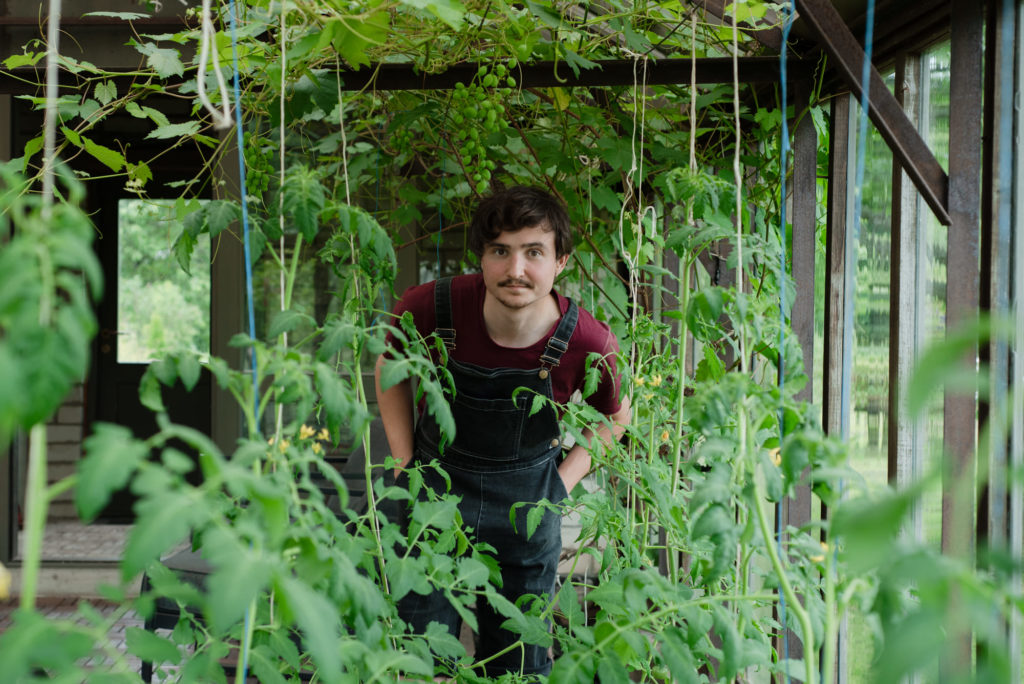
Oleksandr Sirous at the RIXC Fields residency, 2025. Photo: Lelde Gūtmane.
Oleksandr Sirous has been selected for the RIXC Immersive Art and Nature Residency Program 2025 in collaboration with the Photinus Studio (Ukraine).
Oleksandr Sirous is a sound and media artist who works with big data sets and the principles of interaction and communication in web environments. He also creates complex simulation environments using AI. Recently, due to his work with game engines, he has turned more and more to the culture of video games and various game mechanics and new rules of interaction, thus finding new approaches at the intersection of the already established approaches in media art and video games.

Oleksandr Sirous, artwork visualization.
At RIXC Fields Residency, the artist proposes to transform the Salinas farmhouse environment into an active participant within his speculative narrative ecosystem. His project titled Adaptation Period explores the threshold between material and immaterial worlds through evolving hybrid entities – machine-creatures that resonate with invisible forces and environmental signals.
Through building small robotic systems in the metal and wood workshops and cultivating living experiments in the greenhouse, he will create a network of adaptive objects – each reacting to and amplifying site-specific signals. These hybrid systems, inspired by the chaos of frontline ecologies and evolutionary algorithms, will generate a living infrastructure that evolves both digitally (through real-time simulations) and materially (through kinetic sculptures and terrarium-based organisms).
//
Oleksandr Sirous wurde für das RIXC-Residenzprogramm „Immersive Art and Nature“ 2025 ausgewählt, in Zusammenarbeit mit dem Photinus Studio (Ukraine).
Oleksandr Sirous ist ein Klang- und Medienkünstler, der mit großen Datensätzen sowie mit Interaktions- und Kommunikationsprinzipien in Web-Umgebungen arbeitet. Er entwickelt zudem komplexe Simulationssysteme mithilfe von KI.
In letzter Zeit beschäftigt er sich verstärkt mit Game Engines, Videospielkultur und neuen Interaktionsmechaniken und erforscht dadurch Schnittstellen zwischen Medienkunst und Gaming.
Im Rahmen der RIXC Fields Residency schlägt er vor, die Umgebung des Salinas-Bauernhofs in einen aktiven Bestandteil eines spekulativen narrativen Ökosystems zu verwandeln.
Sein Projekt „Adaptation Period“ untersucht die Grenze zwischen materiellen und immateriellen Welten durch hybride, sich entwickelnde Entitäten – maschinenartige Kreaturen, die auf unsichtbare Kräfte und Umweltsignale reagieren.
Durch den Bau kleiner robotischer Systeme sowie Experimente mit lebenden Organismen entsteht ein Netzwerk adaptiver Objekte, das ortsspezifische Signale verstärkt.
Diese hybriden Systeme – inspiriert von Frontlinien-Ökologien und evolutionären Algorithmen – bilden eine lebendige Infrastruktur, die sich sowohl digital (durch Echtzeitsimulationen) als auch materiell (durch kinetische Skulpturen und terrarienartige Organismen) weiterentwickelt.